
GitHub Trending Weekly Picks – 2025-12-08
By zjy365 on 2025-12-08
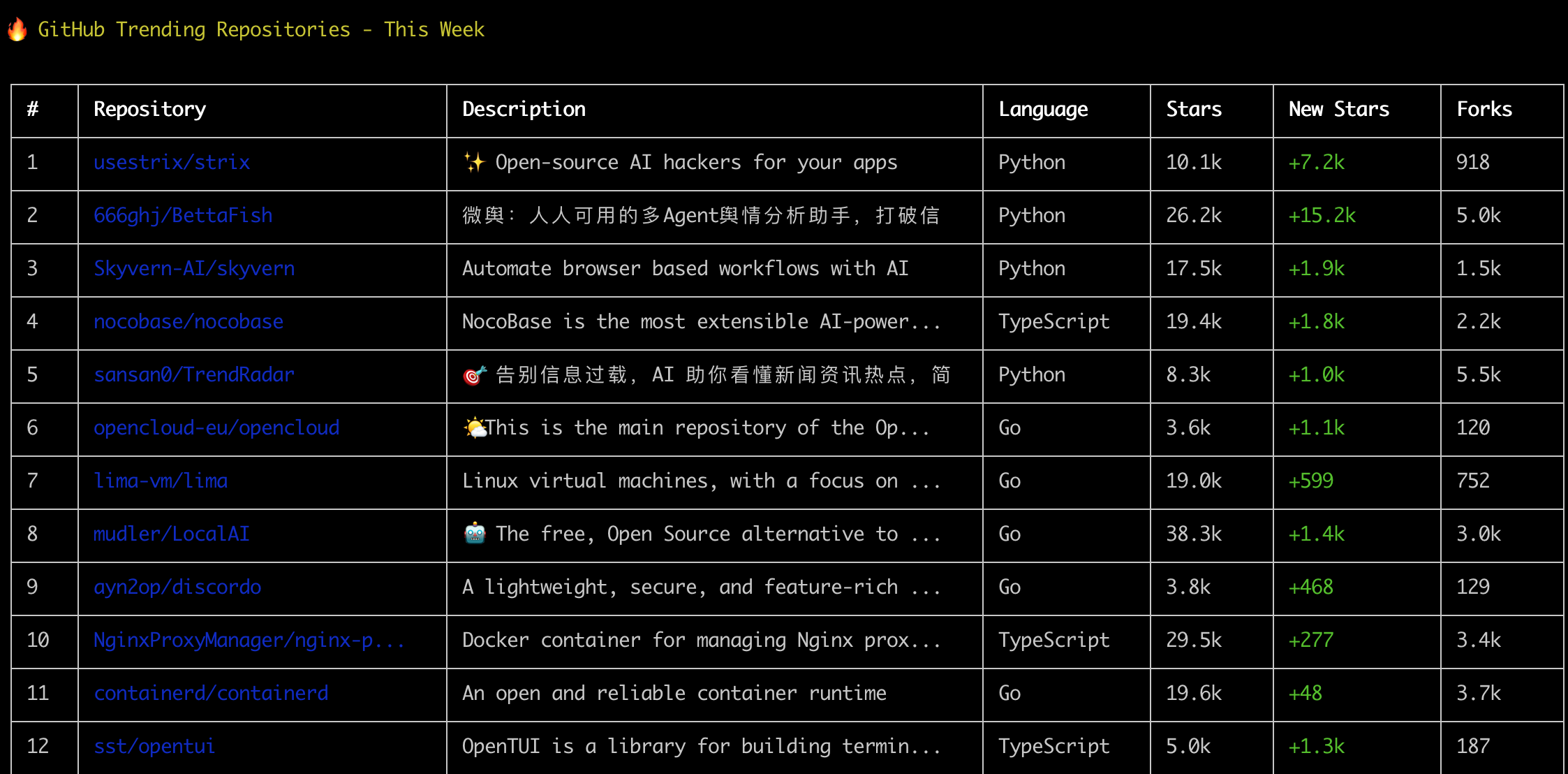
If you’re scanning GitHub Trending Repositories each week to find an edge—faster runtimes, more productive AI agents, better security, or cleaner UIs—this week’s picks (2025-12-08) deliver a powerful mix. From a human-centered web agent and a blazing JavaScript runtime to S3-compatible storage and end-to-end security scanners, these Open Source Projects address real developer pain points: building reliable apps faster, scaling safely, and staying current without burning cycles on evaluation.
In this week’s Weekly Trending roundup, we highlight what’s actually useful, who benefits most, and how to quickly try each project without friction. Whether you’re a staff engineer selecting foundations or a maintainer benchmarking alternatives, the insights below can help you prioritize intelligently.
Call to action: Want more curated Developer Tools and hands-on guidance? Explore collections and playbooks at DevKit.best to accelerate your next build:
- Browse AI & ML tools: https://devkit.best/category/ai-ml
- Discover DevOps and security picks: https://devkit.best/category/devops-security
H2: Weekly Trends Overview: What’s Hot and Why It Matters This week’s GitHub Trending Repositories reveal several strong themes:
- AI agents and coding copilots: magentic-ui, claude-quickstarts, humanlayer, and claude-code underscore how agents are moving from demos to deployable systems.
- Performance and productivity: bun continues to pull attention as a fast runtime, while 1brc spotlights algorithmic craftsmanship in Java.
- Cloud-native data & storage: rustfs and minio represent pragmatic, S3-compatible building blocks for scalable systems.
- Security & compliance: trivy remains a go-to scanner for containers, IaC, SBOM, and repos; cai introduces workflows for AI security.
- Frontend & cross-platform: next.js, Font-Awesome, and lynx offer web builders robust frameworks, assets, and new cross-platform possibilities.
- Mobile & Android navigation: Telegram-iOS and nav3-recipes provide real-world mobile references and Android app patterns.
- Generative media & tooling: ComfyUI and ai-toolkit support diffusion model workflows and finetuning.
Together, these projects reflect developer priorities: ship faster with better defaults, leverage AI responsibly, harden supply chains, and keep UX crisp and consistent.
H2: Repository Deep Dives Below you’ll find concise, actionable breakdowns for each trending repository. Each includes an overview, who it’s for, and a safe Quick Start so you can evaluate in minutes.
H3: 1) magentic-ui (Python) Feature Overview A research prototype of a human-centered web agent designed to interact with web content in a more natural, assistive way.
Core Features
- Human-centered agent behavior and workflows
- Focus on web interaction and assistance
- Research-oriented prototype for experimentation
Use Cases
- Teams exploring web automation and agents
- Researchers and product teams prototyping assistive UIs
Technical Highlights
- Python-based prototype for rapid iteration
- Emphasis on UX and human-agent alignment
Quick Start Guide
- Review the README and examples at the repo: https://github.com/microsoft/magentic-ui
- Clone the project and create a Python virtual environment
- Install dependencies as documented and run example scripts
H3: 2) bun (Zig) Feature Overview A fast JavaScript runtime, bundler, test runner, and package manager in one—focused on speed and developer ergonomics.
Core Features
- Unified toolchain: runtime, bundler, test runner, package manager
- High performance with low startup overhead
- Strong developer experience with simple commands
Use Cases
- Full-stack JS/TS apps seeking faster local dev loops
- Teams consolidating tooling to reduce CI complexity
Technical Highlights
- Implemented in Zig for performance and control
- Designed for speed across bundling, testing, and package installs
Quick Start Guide
- Visit the project for installation steps: https://github.com/oven-sh/bun
- Install Bun per README; verify with bun --version
- Initialize a project and run dev/test scripts using bun commands
H3: 3) rustfs (Rust) Feature Overview An S3-compatible object storage system focused on high performance and coexistence with platforms like MinIO and Ceph. Notably, it highlights 2.3x faster performance than MinIO for 4KB object payloads in its description.
Core Features
- S3-compatible object storage
- High-performance for small payloads
- Supports migration/coexistence with MinIO and Ceph
Use Cases
- Storage backends needing S3 APIs with strong small-object performance
- Hybrid environments migrating between S3-compatible systems
Technical Highlights
- Rust implementation prioritizing speed and safety
- Focus on interoperability and migration paths
Quick Start Guide
- Review deployment guidance at: https://github.com/rustfs/rustfs
- Clone the repo; follow build instructions in README
- Configure S3-compatible endpoints and test with simple object ops
H3: 4) claude-quickstarts (Python) Feature Overview Starter projects to rapidly build deployable applications using the Claude API.
Core Features
- Ready-to-run templates and examples
- Patterns for deploying Claude-powered apps
- Developer-focused quickstart guidance
Use Cases
- Dev teams piloting Claude in production-like setups
- Hackathon teams and POCs needing fast scaffolds
Technical Highlights
- Python examples to speed integration
- Emphasis on deployment readiness and workflows
Quick Start Guide
- Clone the repo and explore the example directories
- Create a Python virtual environment; install dependencies
- Configure your API key and run the sample apps
H3: 5) next.js (JavaScript) Feature Overview The React Framework for production-grade web apps—SSR/SSG, routing, and performance optimizations.
Core Features
- File-based routing and server components
- Hybrid rendering (SSR/SSG/ISR)
- Built-in performance and image optimizations
Use Cases
- Production React apps with SEO and complex routing
- Teams standardizing on a proven React meta-framework
Technical Highlights
- Strong ecosystem and Vercel integration
- Mature dev experience and deployment workflows
Quick Start Guide
- Create a new app with your preferred package manager as per README
- Start the dev server and experiment with pages/app directory
- Deploy via your chosen platform following docs
H3: 6) typescript-go (Go) Feature Overview A staging repository for development of a native port of TypeScript.
Core Features
- Exploration of TypeScript implemented in Go
- Potential for new tooling and runtime integrations
- Staging area for design and experimentation
Use Cases
- Compiler/tooling enthusiasts exploring alternative TS implementations
- Teams evaluating cross-language build workflows
Technical Highlights
- Go-based approach to TS internals and tooling
- Opportunity for integration in Go-heavy environments
Quick Start Guide
- Clone the repo and read the contributing guidelines
- Build per Go toolchain instructions in the README
- Run sample commands or tests to validate the setup
H3: 7) lynx (C++) Feature Overview A cross-platform initiative to empower the web community and invite more contributors to build across platforms.
Core Features
- Cross-platform focus for web-centric apps
- Community-first contributor model
- Emphasis on enabling broader participation
Use Cases
- Teams targeting cross-platform web delivery
- Developers interested in community-driven frameworks
Technical Highlights
- C++ base for performance-sensitive components
- Architecture designed for portability
Quick Start Guide
- Clone the project; review build steps in README
- Install prerequisites and compile using provided scripts
- Run sample apps/demos to validate platform targets
H3: 8) trivy (Go) Feature Overview A comprehensive security scanner for containers, Kubernetes, code repos, and clouds. Also supports secrets detection and SBOM.
Core Features
- Vulnerability and misconfiguration scanning
- Secrets detection and SBOM generation
- Coverage across containers, K8s, IaC, and repos
Use Cases
- DevSecOps pipelines and pre-commit checks
- Compliance posture assessments across cloud-native stacks
Technical Highlights
- Go-based scanner with broad ecosystem integrations
- CLI-first with CI/CD workflows in mind
Quick Start Guide
- Install Trivy via README instructions
- Run a scan against a container image or local repo
- Integrate into CI to enforce baselines
H3: 9) Font-Awesome (JavaScript) Feature Overview Iconic SVG, font, and CSS toolkit for scalable, consistent UI icons.
Core Features
- Extensive icon library across categories
- SVG and web font delivery options
- Easy integration with web frameworks
Use Cases
- Web apps needing consistent iconography
- Design systems and component libraries
Technical Highlights
- Mature API and theming capabilities
- Community adoption and continuous updates
Quick Start Guide
- Include via CDN or package manager per README
- Reference icons in your HTML or components
- Customize sizing, styles, and accessibility attributes
H3: 10) 1brc (Java) Feature Overview The One Billion Row Challenge: a study in high-performance aggregation of 1B text rows in Java.
Core Features
- Performance-oriented parsing and aggregation
- Examples of algorithmic/memory optimization
- Educational benchmark for Java performance
Use Cases
- Performance engineers and systems developers
- Teams learning micro-optimizations and profiling
Technical Highlights
- Java-based exploration of throughput and latency
- Multiple approaches to illustrate tradeoffs
Quick Start Guide
- Clone the repo and import into your Java toolchain
- Build with your preferred build system per README
- Run the challenge datasets and compare variants
H3: 11) nav3-recipes (Kotlin) Feature Overview Practical recipes for common use cases with Jetpack Navigation 3.
Core Features
- Pattern-based examples for Navigation 3
- Clear guidance on common flows
- Kotlin-first Android app samples
Use Cases
- Android developers upgrading or adopting Nav 3
- Teams standardizing navigation patterns
Technical Highlights
- Kotlin idioms for modern Android
- Sample-first documentation for quick learning
Quick Start Guide
- Clone the repository into Android Studio
- Build and run sample modules on an emulator
- Adapt recipes into your project
H3: 12) ai-toolkit (Python) Feature Overview A training toolkit for finetuning diffusion models—streamlining generative image workflows.
Core Features
- Utilities for dataset prep and training
- Finetuning pipelines for diffusion models
- Config-driven experimentation
Use Cases
- ML practitioners finetuning generative models
- Teams building custom image pipelines
Technical Highlights
- Python-first ML workflow ergonomics
- Modular design to plug in new components
Quick Start Guide
- Set up a Python environment and install dependencies
- Prepare your dataset and configuration files
- Launch training following example scripts
H3: 13) humanlayer (TypeScript) Feature Overview Tools to help AI coding agents solve hard problems across complex codebases.
Core Features
- Agent workflows for code understanding
- Support for large, multi-language repos
- Focus on task decomposition and execution
Use Cases
- Teams adopting agentic coding for refactors
- Maintainers triaging issues across big codebases
Technical Highlights
- TypeScript-based orchestration and SDK patterns
- Emphasis on reliability across complex tasks
Quick Start Guide
- Clone the repo; install via your package manager
- Configure project metadata and permissions
- Run example agent tasks against a sample repo
H3: 14) claude-code (Shell) Feature Overview An agentic coding tool in your terminal—helps execute routine tasks, explain code, and manage git via natural language.
Core Features
- Terminal-first, natural language commands
- Codebase understanding and explanations
- Git workflow assistance and automation
Use Cases
- Developers accelerating routine workflows
- Teams standardizing terminal-based assistants
Technical Highlights
- Shell integration for local workflows
- Agentic task execution for repeatability
Quick Start Guide
- Follow setup instructions in the README
- Grant repository access and initialize the agent
- Try common flows: explain code, open PRs, run tests
H3: 15) once-campfire (Ruby) Feature Overview A Ruby-based project from Basecamp; currently trending with limited public description.
Core Features
- Ruby application patterns from an experienced team
- Opinionated code and structure
- Reference-quality coding style
Use Cases
- Rubyists looking for real-world patterns
- Teams studying ecosystem best practices
Technical Highlights
- Ruby on Rails ecosystem familiarity
- Emphasis on readable, maintainable code
Quick Start Guide
- Clone the repo and install Ruby dependencies
- Set up environment variables per README
- Run local server and explore routes/features
H3: 16) Telegram-iOS (Swift) Feature Overview The official iOS client for Telegram, providing a production-grade Swift codebase.
Core Features
- Full-featured messaging client
- Robust networking and UI layers
- Production-scale performance
Use Cases
- iOS devs studying large-scale Swift projects
- Teams learning advanced messaging patterns
Technical Highlights
- Swift codebase with optimized UI
- Real-world architecture and performance techniques
Quick Start Guide
- Open the project in Xcode per README steps
- Resolve dependencies and build
- Run on device or simulator and examine modules
H3: 17) cai (Python) Feature Overview Cybersecurity AI (CAI), a framework for AI Security—focuses on applying AI to security workflows.
Core Features
- AI-driven security tasks and analyses
- Framework approach to experiment and deploy
- Extensible components and pipelines
Use Cases
- Security teams augmenting workflows with AI
- Researchers prototyping AI security tools
Technical Highlights
- Python-based with modular design
- Emphasis on real-world security use cases
Quick Start Guide
- Create a Python environment and install dependencies
- Configure example pipelines as per README
- Run sample analyses and adapt to your data
H3: 18) ComfyUI (Python) Feature Overview A powerful, modular diffusion model GUI with a graph/nodes interface for flexible generative workflows.
Core Features
- Node-based UI for diffusion pipelines
- Modular backends and API
- Strong community ecosystem
Use Cases
- Artists and ML engineers building image workflows
- Teams prototyping visual generative apps
Technical Highlights
- Python backend with extensible nodes
- GUI-first approach for rapid experimentation
Quick Start Guide
- Follow README to install runtime and dependencies
- Launch the GUI and open example graphs
- Customize node chains for your use case
H3: 19) minio (Go) Feature Overview A high-performance, S3-compatible object store, open-sourced under GNU AGPLv3.
Core Features
- S3-compatible APIs for object storage
- Horizontal scalability and performance
- Strong operational tooling and docs
Use Cases
- Private cloud and on-prem object storage
- Cloud-native apps standardizing on S3 APIs
Technical Highlights
- Go implementation optimized for throughput
- Mature ecosystem and deployment patterns
Quick Start Guide
- Download and run the MinIO server as per README
- Create buckets and test with S3-compatible clients
- Integrate into your application via S3 SDKs
H2: Comparison Analysis Table Below is a high-level, editorial comparison to help you prioritize which GitHub Trending Repositories to try first. Star counts reflect the snapshot provided with this week’s list.
| Repository Name | Primary Purpose | Programming Language | Stars Count | Activity Level | Best Use Cases | Learning Curve | Community Support | Advantages (✅) | Limitations (❌) | Recommendation Score |
|---|---|---|---|---|---|---|---|---|---|---|
| magentic-ui | Human-centered web agent prototype | Python | 8796 | Trending research | Agent UX prototyping, web automation | Medium | Growing | ✅ Human-centered focus, ✅ Python ecosystem | ❌ Prototype maturity, ❌ Evolving APIs | 8.0/10 |
| bun | JS runtime + bundler + test + pkg mgr | Zig | 84527 | Mature & trending | Fast full-stack JS/TS dev | Low-Medium | Large | ✅ Speed, ✅ All-in-one toolchain | ❌ Ecosystem parity nuances | 9.0/10 |
| rustfs | S3-compatible object storage | Rust | 15560 | Trending infra | Small-object performance S3 workloads | Medium | Growing | ✅ Performance, ✅ Interop with MinIO/Ceph | ❌ Operational maturity to assess | 8.5/10 |
| claude-quickstarts | Claude API starter apps | Python | 11168 | Trending templates | Rapid AI app prototyping/deploy | Low | Growing | ✅ Fast starts, ✅ Deploy-focused | ❌ Template scope limits | 8.2/10 |
| next.js | React framework | JavaScript | 136297 | Mature & trending | SEO-friendly, production React | Low-Medium | Very large | ✅ Ecosystem, ✅ Performance features | ❌ Framework conventions to learn | 9.2/10 |
| typescript-go | Native TS in Go (staging) | Go | 23141 | Trending experimental | Compiler/tooling exploration | Medium-High | Growing | ✅ New possibilities, ✅ Go integration | ❌ Early-stage, ❌ API flux | 7.8/10 |
| lynx | Cross-platform web enablement | C++ | 13809 | Trending community | Cross-platform web apps | Medium | Emerging | ✅ Portability, ✅ Perf-focused | ❌ Early docs/patterns may evolve | 7.9/10 |
| trivy | Security scanning suite | Go | 30257 | Mature & trending | DevSecOps, SBOM, secrets | Low-Medium | Large | ✅ Broad coverage, ✅ CI-friendly | ❌ Findings triage required | 9.0/10 |
| Font-Awesome | Icon toolkit (SVG, fonts, CSS) | JavaScript | 75942 | Mature & trending | Design systems, web UIs | Low | Very large | ✅ Huge library, ✅ Easy integration | ❌ Icon licensing/variants to review | 9.1/10 |
| 1brc | Java performance challenge | Java | 7768 | Trending educational | Perf engineering learning | Medium | Large | ✅ Clear patterns, ✅ Benchmark mindset | ❌ Not a drop-in library | 8.0/10 |
| nav3-recipes | Jetpack Navigation 3 recipes | Kotlin | 987 | Trending Android | Android navigation patterns | Low-Medium | Emerging | ✅ Practical recipes, ✅ Modern Kotlin | ❌ Recipe scope limited | 7.9/10 |
| ai-toolkit | Finetuning diffusion models | Python | 7782 | Trending ML | Generative image finetuning | Medium | Growing | ✅ Training utilities, ✅ Config-driven | ❌ Compute requirements | 8.3/10 |
| humanlayer | AI coding agents for complex repos | TypeScript | 7420 | Trending AI dev | Refactors, multi-repo tasks | Medium | Growing | ✅ Agent orchestration, ✅ Complex code support | ❌ Setup/guardrails to tune | 8.4/10 |
| claude-code | Terminal AI coding agent | Shell | 44958 | Mature & trending | Terminal workflows, git ops | Low | Large | ✅ Natural language ops, ✅ Code understanding | ❌ Local context limits to manage | 8.8/10 |
| once-campfire | Ruby project (Basecamp) | Ruby | 3680 | Trending | Ruby patterns, study project | Low-Medium | Growing | ✅ Opinionated patterns | ❌ Sparse public description | 7.6/10 |
| Telegram-iOS | iOS client | Swift | 7642 | Mature & trending | Swift architecture study | Medium-High | Large | ✅ Production-grade code | ❌ Complex codebase | 8.4/10 |
| cai | Cybersecurity AI framework | Python | 6160 | Trending security | AI-assisted security tasks | Medium | Growing | ✅ Extensible, ✅ Practical scenarios | ❌ Data sensitivity handling | 8.2/10 |
| ComfyUI | Diffusion model GUI (nodes) | Python | 96045 | Mature & trending | Visual gen workflows | Low-Medium | Very large | ✅ Powerful GUI, ✅ Modular nodes | ❌ Performance tuning needed | 9.0/10 |
| minio | S3-compatible object store | Go | 59036 | Mature & trending | On-prem/private cloud storage | Medium | Very large | ✅ Proven S3 APIs, ✅ High performance | ❌ Ops/cluster complexity | 9.1/10 |
H2: Use Cases & Best Practices Scenario 1: Accelerate full-stack JS development
- Challenge: Slow installs, multiple tools, and sluggish tests sap developer momentum.
- Solution: Consolidate on bun for runtime, bundling, testing, and package management.
- Expected Outcome: Faster local feedback loops and simpler CI, enabling more frequent merges and releases.
- Tip: Start with a small service to derisk before rolling out organization-wide. For more JavaScript ecosystem picks, see https://devkit.best/category/javascript
Scenario 2: Secure the software supply chain in CI
- Challenge: Vulnerabilities and misconfigurations slip through without consistent scanning coverage.
- Solution: Integrate trivy scans for containers, IaC, and repos; generate SBOM in CI.
- Expected Outcome: Earlier detection, fewer production surprises, and clearer audit trails.
- Tip: Gate merges on critical findings; triage non-critical items in a weekly security review.
Scenario 3: Prototype an AI assistant workflow quickly
- Challenge: Starting from scratch with prompts, APIs, and deployment slows experimentation.
- Solution: Use claude-quickstarts to stand up minimal deployable apps with the Claude API.
- Expected Outcome: A working demo ready to iterate with stakeholders in a day, not a week.
- Tip: Keep data handling minimal and documented; add guardrails as you expand. Explore more AI tools at https://devkit.best/category/ai-ml
Scenario 4: Build S3-compatible storage with performance headroom
- Challenge: Need S3 APIs for small-object-heavy workloads and migration flexibility.
- Solution: Evaluate rustfs for small object performance and minio for a proven production baseline.
- Expected Outcome: Better small-object throughput and smooth integration with S3 clients.
- Tip: Benchmark against your real traffic profile; align erasure coding and replication to SLAs.
Scenario 5: Standardize Android navigation patterns
- Challenge: Inconsistent navigation leads to bugs and brittle back stacks.
- Solution: Adopt nav3-recipes as a reference for Jetpack Navigation 3 patterns.
- Expected Outcome: Cleaner, predictable navigation with fewer regressions and easier onboarding.
- Tip: Create an internal template app derived from the best-fitting recipe. For more mobile/DevOps patterns, check https://devkit.best/category/devops-security
H2: How to Choose the Right Project for You Use this simple decision path to shortlist GitHub Trending Repositories effectively:
- Need immediate productivity boosts in JS/TS?
- Choose bun for unified tooling, and next.js if you’re building React apps with SEO.
- Hardening pipelines or preparing for audits?
- Start with trivy for scans and SBOM; complement with cai if you’re exploring AI in security operations.
- Storage with S3 APIs on-prem or hybrid?
- Compare rustfs (small-object performance; coexistence focus) and minio (battle-tested operational maturity).
- Prototyping AI agents and coding assistants?
- Try magentic-ui for human-centered agent patterns; use claude-quickstarts to ship a minimal deploy; add claude-code or humanlayer for codebase-scale tasks.
- Building polished UIs fast?
- Font-Awesome for icons; lynx for cross-platform potential; next.js for end-to-end React framework support.
- Learning and reference codebases
- Study 1brc for performance techniques, Telegram-iOS for production Swift, nav3-recipes for Android navigation, and ComfyUI/ai-toolkit for diffusion model workflows.
CTA: Ready to go deeper with curated stacks and practical templates? Visit https://devkit.best/ and explore playbooks tailored to modern Developer Tools.
H2: Frequently Asked Questions
Q1: How is this week’s GitHub Trending Repositories list selected?
A:
The list summarized here reflects trending activity on GitHub during the week of 2025-12-08 and includes the star and fork counts provided in the snapshot. We prioritize practical insights: who benefits, how to evaluate, and safe ways to try projects quickly. For additional curated tool stacks, see our Developer Tools category at https://devkit.best/category/devops-security.
Q2: What signals should I use to evaluate a trending project’s maturity?
A:
Consider documentation quality, release cadence, issue triage responsiveness, and ecosystem integrations. For infrastructure and security tools, look for deployment guides and CI examples. For web frameworks like next.js, check real-world case studies and plugin ecosystems. Also, test against your workflow before adoption. You can browse related insights in our blog, such as performance-oriented guides at https://devkit.best/blog/nextjs-performance-guide.
Q3: Are star counts alone a good reason to adopt a project?
A:
No. Stars indicate interest, not fit or stability. Balance stars with compatibility, operational needs, and maintainability in your stack. For example, pair rustfs evaluations with a baseline like minio and measure using your traffic profile. For AI tools, start with a minimal proof of concept and expand as guardrails mature. Explore more comparative guidance at https://devkit.best/category/ai-ml.
Q4: What’s the safest “first step” to try a trending repo?
A:
Clone the repo, follow the README precisely, and run example commands in a sandboxed environment. Keep secrets and production data out of early tests. For security-sensitive areas, add trivy scans in CI before broad trials. When you’re comfortable, move to a small internal service trial and gather metrics.
Q5: Which repos are best suited for teams on tight timelines?
A:
- bun: quickly accelerates JS/TS workflows
- next.js: production-ready React with batteries included
- trivy: instant value in CI security scanning
- claude-quickstarts: deployable AI app scaffolds within hours For more time-saving picks, visit https://devkit.best/category/javascript.
H2: References
- magentic-ui repository: https://github.com/microsoft/magentic-ui
- bun repository: https://github.com/oven-sh/bun
- rustfs repository: https://github.com/rustfs/rustfs
H2: Conclusion The 2025-12-08 GitHub Trending Repositories spotlight where development is headed: AI agents moving into real workflows, faster runtimes simplifying tooling, S3-compatible storage options broadening, and security scanning becoming a default. Use the comparison table and best practices above to shortlist projects aligned with your goals—and start with small, measurable pilots.
Ready to accelerate your next build with curated stacks and actionable playbooks? Explore more at https://devkit.best/.
<script type="application/ld+json"> { "@context": "https://schema.org", "@type": "Article", "headline": "GitHub Trending Weekly Picks – 2025-12-08", "description": "Discover this week’s GitHub Trending Repositories (2025-12-08). Explore standout open source projects, key features, and use cases. Dive in and build today.", "image": "https://devkit.best/images/blog/github-trending-placeholder.png", "author": { "@type": "Person", "name": "zjy365" }, "publisher": { "@type": "Organization", "name": "DevKit.best", "logo": { "@type": "ImageObject", "url": "https://devkit.best/logo.png" } }, "datePublished": "2025-12-08", "dateModified": "2025-12-08", "mainEntityOfPage": { "@type": "WebPage", "@id": "https://devkit.best/blog/github-trending-repositories-2025-12-08" }, "articleSection": "Developer Tools", "keywords": ["GitHub Trending", "Open Source Projects", "Developer Tools"], "about": [ { "@type": "Thing", "name": "GitHub Trending Repositories" }, { "@type": "Thing", "name": "Open Source Software" } ] } </script> <script type="application/ld+json"> { "@context": "https://schema.org", "@type": "FAQPage", "mainEntity": [ { "@type": "Question", "name": "How is this week’s GitHub Trending Repositories list selected?", "acceptedAnswer": { "@type": "Answer", "text": "The list reflects trending activity on GitHub during the week of 2025-12-08 and includes the star and fork counts provided in the snapshot. We prioritize practical insights: who benefits, how to evaluate, and safe ways to try projects quickly." } }, { "@type": "Question", "name": "What signals should I use to evaluate a trending project’s maturity?", "acceptedAnswer": { "@type": "Answer", "text": "Check documentation quality, release cadence, issue triage responsiveness, and ecosystem integrations. For infra and security tools, look for deployment guides and CI examples. Test against your real workflow before adoption." } }, { "@type": "Question", "name": "Are star counts alone a good reason to adopt a project?", "acceptedAnswer": { "@type": "Answer", "text": "No. Stars indicate interest, not fit or stability. Balance stars with compatibility, operational needs, and maintainability in your stack. Start with a minimal proof of concept and measure against your requirements." } }, { "@type": "Question", "name": "What’s the safest “first step” to try a trending repo?", "acceptedAnswer": { "@type": "Answer", "text": "Clone the repo and follow the README precisely in a sandboxed environment. Keep secrets and production data out of early tests. For security-sensitive areas, add scanning in CI before broad trials." } }, { "@type": "Question", "name": "Which repos are best suited for teams on tight timelines?", "acceptedAnswer": { "@type": "Answer", "text": "bun accelerates JS/TS workflows, next.js offers production-ready React, trivy provides immediate security value, and claude-quickstarts enables deployable AI app scaffolds within hours." } } ] } </script>